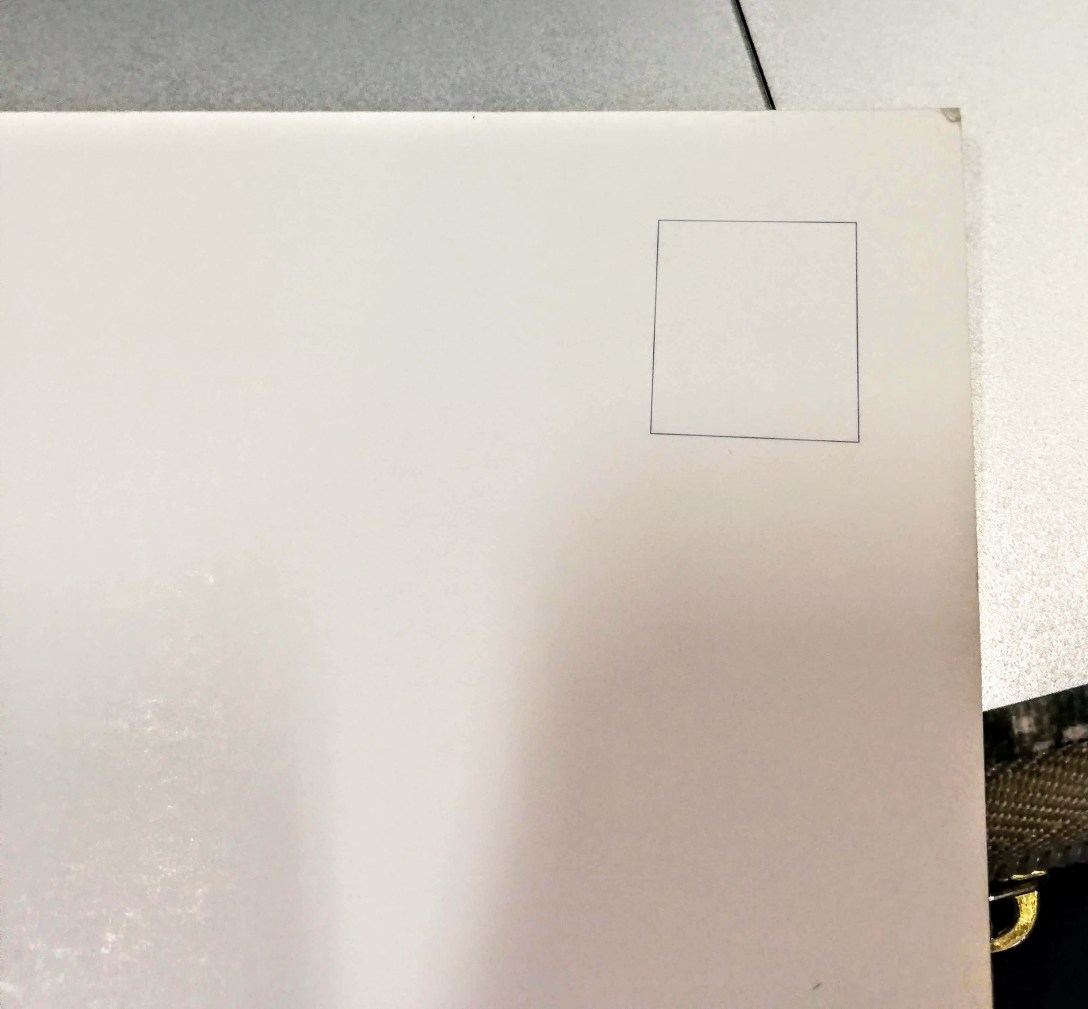
Not too glossy, though. If it were a sunny day and you were standing outside with this rectangular piece of card, your mum wouldn’t shout at you to stop glinting her with that thing.
It gives the illusion of being pretty sturdy. You can bend it and it won’t crease. But, if you really wanted it to crease, you could do that too. I didn’t. One of its ears isn’t as pointy as the rest. This reminds you it has had to travel from somewhere to get to your hands. Maybe from a gift shop, to a suitcase, to you in this classroom. But even before that, from a printer of some sort. How many others like you were printed? One hundred? One thousand? Five million?
Are you still unique?
When I said it’s rectangular, I meant it has a typical postcard size and shape. Double-sided. On the backside, there is one rectangle in the top right corner. This is how we know it’s the backside. It’s an empty, simple, thin box, quietly willing you to stamp it up and post it on to someone you care enough about to buy stamps for. It urges you to let it continue on its journey, maybe to a mantelpiece somewhere, maybe to a tarnished tin filled with other bits and scraps of cherished memories.
Let’s skip to the front side. I know that’s what you came here for. Well, let me tell. you, it’s a little peculiar. You’d expect there to be a seaside picture, or even a collage of pictures (a donkey, a semi-impressive building, some ice-creams, a sunset?). You wouldn’t be wrong to expect even a place name stamped there too (Bondi Beach, Blackpool, The Lake District, Temby), with some merry pre-destined message like, “Wish you were here!”
Instead, there’s a poem.
This is a bold statement, because what defines a poem? All I can say is, my gut tells me it’s a poem and you can choose to trust me or not.
The poem is positioned in the middle of the card, centralised, drawing us into the centre. This creates a chunky off-white frame around the text, almost accidentally.
The poem is written typed printed in a soft baby blue. It’s laser-printed, smooth. But “laser-printed” feels too violent for this poem. The colour and style of the printed words encourages one to think they’ve just always been there. Or that they just popped onto the rectangular card one-day (out of the blue).
The poem uses no caps lock, no full stops, sans serif, simple,
to learn to look at the sea is to learn to look
This is the first line. It’s not italicized on the card. That would be too much. Too rushed or whispered. This, however, is stated.
“to learn to… to learn to… to learn to” – this is written ten times in total, twice on each line. There are five lines. “To learn” – an infinitive. No inflection here, no direction, no imperative. Subtle.
The sea we don’t see isn’t stormy. It’s light blue and knowing. Considerate. It understands human error (at least, I hope so. That’s the sea I see).
The longest line of text is the middle one, line number three:
to learn to think about the sea is to learn to think
“sea” runs through the poem, a narrative ripple, a literal ripple of text. It implores us, the readers, the see-ers, the sea-ers, to look, listen, think, learn, forget. But not like a crabby high-school teacher. More like a caring grandfather who knows the changeability of the world and knows when to ride the waves.
My gut also assures me this is a poem because it has a title. Not on the front, though. We’re on the back again.
Five Waves
Thomas A Clark.
“Five Waves”? Why not one sea? Why only five? Why capitalise now? Are waves even countable if they’re countless? Five waves for five lines, five hellos or goodbyes? Greetings or farewells? Both at once? Is that possible?
an island postcard (2)
published by Essence Press 2003
http://www.essencepress.co.uk
island is a biannual publication for writing inspired by nature
This is all that’s left on the card. It’s the cheat sheet, the bit to not really read. Usually, anyway. But, this little chunk of text positions us on an island. Detached, remote, removed from the hubbub of, well, a non-island. And I know if you zoom out enough all masses of land are surrounded by water but this postcard itself is “an island postcard (2)”. We aren’t on the waves or above the waves or just imagining the waves at all, we are on an island, watching the waves. Which begs the question, where is an island postcard (1)? Two island postcards, separated by time (since 2003?), but not by the sea. The sea and its waves are what joins these two equiangular quadrilaterals.
island is a biannual publication for writing inspired by nature.
Do you feel inspired?

 To Be T4bb